
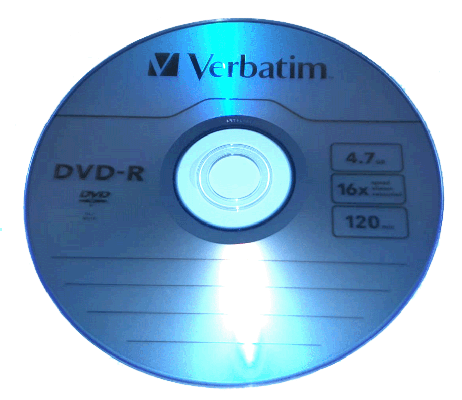
Merkmale der Digital Video Disc (DVD)
Definition & Entstehung
Die Digital Video Disc (DVD) ist ein optisches Speichermedium, das Mitte der 1990er‑Jahre als Nachfolger der Videokassette
und als Weiterentwicklung der CD entwickelt wurde. Ziel war eine höhere Speicherkapazität,
digitale Bild‑ und Tonqualität sowie ein universelles Medium für Film, Daten und interaktive Inhalte.
Bauform & Kompatibilität
-
Standarddurchmesser: 12 cm, Dicke: 1,2 mm (identisch zur CD).
-
Es existieren auch 8‑cm‑Mini‑DVDs für Camcorder.
-
DVD‑Player sind in der Regel abwärtskompatibel zu Audio‑CDs.
-
Unterschiedliche DVD‑Formate (DVD‑Video, DVD‑ROM, DVD‑R/RW, DVD+R/RW) erfordern kompatible Laufwerke.
-
Region‑Codes können die Abspielbarkeit von DVD‑Video einschränken.
Speicherschichten & Kapazität
-
Single Layer (SL): ca. 4,7 GB
-
Dual Layer (DL): ca. 8,5 GB
-
Double‑Sided (DS): bis zu 9,4 GB (SL) bzw. 17 GB (DL)
-
Höhere Kapazität durch engere Spurführung und kürzere Laserdioden‑Wellenlänge (650 nm statt 780 nm bei CDs).
Bild‑ und Tonqualität
-
Digitales Video im MPEG‑2‑Format, variable oder konstante Bitrate.
-
Auflösung (PAL): 720×576 Pixel, deutlich höher als VHS.
-
Mehrkanalton möglich (Dolby Digital, DTS, PCM).
-
Menüs, Kapitelwahl und Zusatzmaterial sind integraler Bestandteil des Formats.
Datenquelle: KI (Copilot)